
CES Vestamager, Periode 4
I’m here with a quick recap of the 4th ringing session that took place on Wednesday this week. We were joined by approx. 15 young nature enthusiasts from the student union Vild Campus. They had been sleeping in the shelter close to the site and showed up right before the first round. It was quite a chill morning, so we had time to show them the whole process, talk about the individual species and their phenology, and ringing in general. Some of the students that stayed with us until the end got rewarded with a flock of five Long-tailed Tits in the last net, and a Great Spotted Woodpecker as the last bird of the day.
As a ringer, you never stop learning (that might be said for all your life endeavors – I surely hope so!), and I have been getting more into the sexual differences in breeding biology of the species we catch – like how can you use the presence of a brood patch (BP) to sex a bird species? As an example, all the Long-tailed Tits we caught had a well-defined BP, making them all females. According to the French Ringer’s Guide (Demongin, 2016), only females of this species are incubating, unlike Great Tit and Blue Tit. The Great Spotted Woodpecker we caught was a young male that had a very wrinkly BP; for this species, both males and females incubate.
With this session we crossed the first milestone of having 100 catches! We now have 128 catches and 15 species 😊
| CES Vestamager | 03-06-2026 | |
| Species | Recaptured | Ringed |
| Blåmejse (Blue Tit) | 2 | |
| Gransanger (Chiffchaff) | 1 | |
| Halemejse (Long-tailed Tit) | 1 | 5 |
| Havesanger (Garden Warbler) | 1 | |
| Løvsanger (Willow Warbler) | 6 | 1 |
| Musvit (Great Tit) | 2 | |
| Skovpiber (Tree Pipit) | 3 | 1 |
| Solsort (Blackbird) | 1 | 1 |
| Stor Flagspætte (Great Spotted Woodpecker) | 1 | |
| Tornsanger (Common Whitethroat) | 1 | 2 |
| 14 | 15 | |
| Total | 29 | |
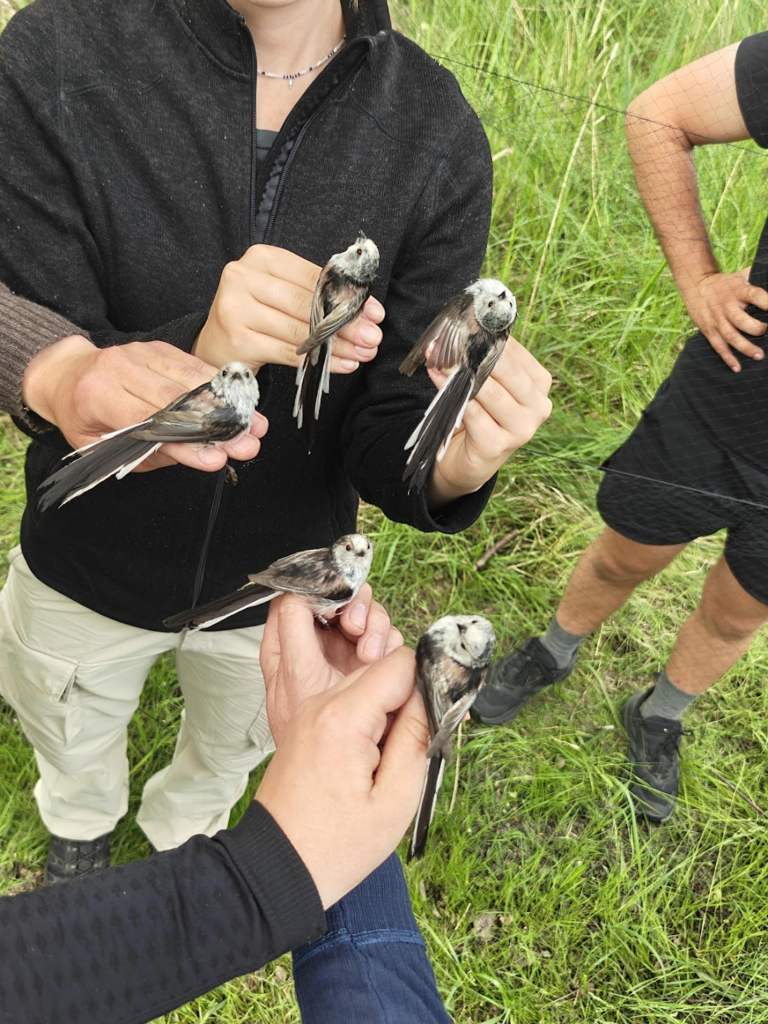
A flock of female Long-tailed Tits (all having BP = 2)
